Everyone Is a Little More Persuasive

A colleague nudged me to finish a task. The note was cleanly formatted. It ended with a reminder of why it mattered and how finishing it would help us. I closed the note with some momentum, gently compelled.

I don’t know whether she used AI and it doesn’t matter. I use LLMs to frame my arguments favourably, and it makes them better. But the experience left me with the question: what happens when everyone is a little more persuasive?

Important projects arrive with a gravity. A well-built pitch that pulls you along is a signal. Now every play for your time, attention, and money can be that well built. Everything feels that intense.

That flat intensity has a cost. We barely navigate our calorie-rich food environment, and persuasion is heading the same way. Every commercial tuned to your deepest wants. The plainer cost is energy: it will take more just to get through the day making decisions. Perceptual defaults are sticky. Compelling things will be measured on the pre-AI scale until we recalibrate. We will keep reading polish as importance.

Receiving

The people who do well will be the ones who can tell two compelling pitches apart. One serves their goals and refills their tanks. The other doesn’t. That takes focus: an opinionated rubric, autonomy, and the guts to decide fast. The environment will reward people and firms who have a system for it, even an imperfect one.

I don’t have a good system. I have a question borrowed loosely from Buddhism: is this chanda or tanha? Tanha is craving, the pull a good pitch manufactures. To me Chanda is the desire to act, the wish to make something well. Will this product or project help me explore, find what’s right, and shape it properly, or does it just pull?

Sending

As persuasion gets cheaper to produce, it gets harder to stick. After turning down a dozen polished pitches, the cost of earning a yes on the thirteenth goes way up. It makes trust worth far more. Once you’ve earned it, don’t spend it carelessly. Keep reinforcing the relationship, and keep reinvesting in it. Share credit with colleagues who’ve joined you along the way. Give customers more than they paid for. You want people to stick with you.

Maybe this only matters to someone susceptible to bolded section headers. My colleague’s nudge was both formatted and trusted. The relationship was a part of it. The persuasion changed what I brought to it.
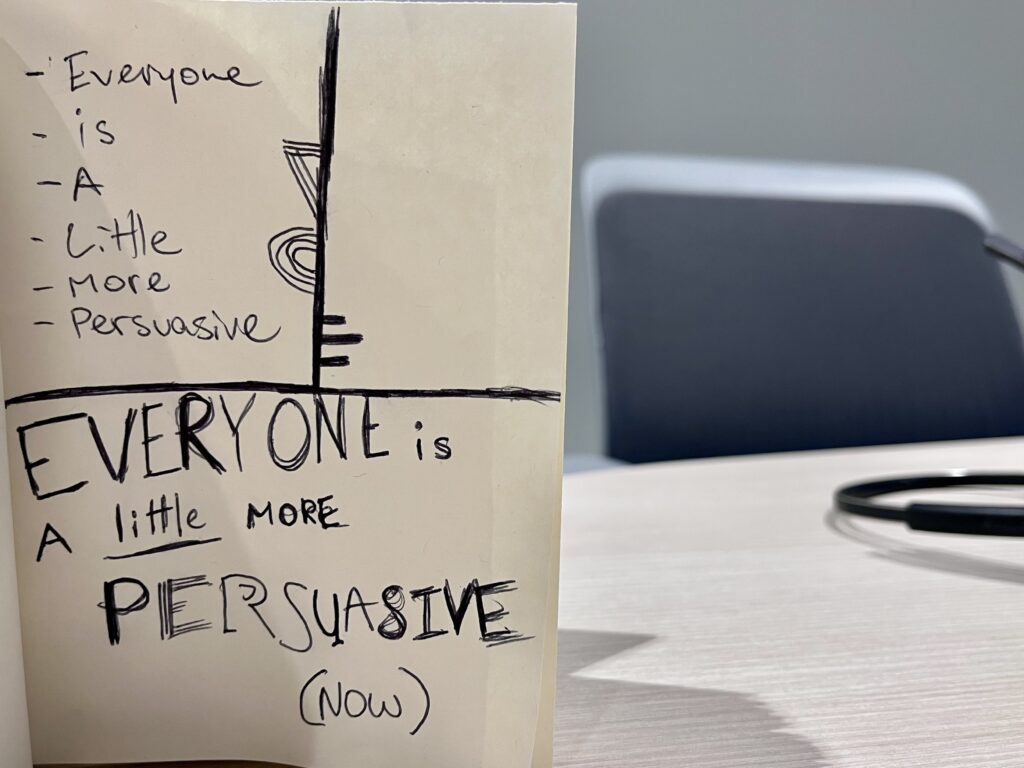
Decorative drawing of post title in a notebook.

The Last Days of Good Enough Design

Drainage Ditch from a low angle, generated by AI

I am a practitioner of good enough design. I focus on a question: does this remove effort for the viewer? Clear hierarchy, nothing to decode, no hunting for the point. In my darker moments, I’ve been counting on good enough design to keep me employed. I can make complex things simpler.

This week I got access to Copilot.

I started by improving an old deck. Fonts, weights, alignment were right almost immediately. It passed the test. I found it easier to navigate. Not better than me, but much, much faster.

Then I went heavy with real work. It misses small things: the choices that direct the eye. One slide gave its conclusion nearly the same weight as a point about process. I resized and reweighted to get the hierarchy to my taste. Give me unlimited time and I’d win. With the minutes I actually have, I don’t. This isn’t Chip Kidd or Dieter Rams, but it doesn’t need to be.

Taste is knowing what good enough looks like, not necessarily making the thing good enough. But to the degree I have any design taste, I got it by making.

My favourite mistake is never killing my darlings. I still want the viewer to see all my hard work. It took years of overloaded slides to learn the empathy of design. One idea per slide. A story where each idea follows from the last. Only what the viewer needs.

Copilot rarely makes that mistake. It gives you restraint as the default. A junior analyst rarely builds the overloaded slide, feels why it fails, or learns to cut.

This week, the good enough design moat I thought I had feels like a damp ditch, dug one bad slide at a time.

If only the slide matters, those bad slides were never needed. If the maker matters, the loop that taught me is gone, and something has to replace it.

No One Drew Up the Fog Machine

Created by Chat GPT. Image of a foggy nameless baseball stadium

INT. BLUE JAYS MANAGER’S OFFICE — ROGERS CENTRE — DAY

JOHN SCHNEIDER, obviously sunburnt, stands with a clipboard. He clears his throat.

SCHNEIDER

Guys. Can we just — can we do the thing from last year?
You know… Next man up. The jacket thing.

(reading, then abandoning the clipboard)

SCHNEIDER (CONT’D)

That was good. I liked that.

(He catches a glimpse of himself in the mirror)

SCHNEIDER (CONT’D)

…maybe we should get a new jacket?


The 2025 Blue Jays were World Series finalists beloved for their La Gente del Barrio attitude. Next man up. Contact. Next batter brings you home. They took the Dodgers to seven games, and they did it in such a likeable way. It was a particular kind of winning — it looked fun. It looked like a team.

They brought back almost all of the same pieces this year. Yet they slumped — under .500 for most of the season. It hasn’t looked fun. It hasn’t looked like much of anything.

It must be frustrating for every level of leadership — to try to will the spirit of last year back into being with everything they’ve got and find it doesn’t work.

The trade deadline came. Beloved pieces went out. New blood came in. Suddenly, there’s a little fun in the dugout. Some smiles. Some next man up. At the time of writing they’ve won 7 of their last 10, and it may very well fall apart again. It feels like random chance that this particular combination of players is sparking — but that’s what leaders, in all of their incarnations, actually control: not the spark, just who’s standing near the match.

This recent winning stretch came with something else. Fog machines. Strobe lights. The clubhouse turning into a nightclub after every win. Nobody in the front office drew that up. The easy move is to shut it down — get back to business, we’re in a wildcard race. The only decision leadership made was not to stop it.

What made last year’s team enchanting was the camaraderie — that’s what had people on their feet. It was a team you can imagine being part of. They were a bunch of individuals doing their jobs and all pulling hard in the same direction. The lesson for leadership isn’t to throw your team a party or get them a new jacket. Leadership’s real job is unglamorous twice over — choose who stands near the match, then have the discipline not to smother the sparks.

h/t to the Yeast Enderz who provided feedback on this post. 

This is the Good Part

In 1930, John Maynard Keynes predicted that within a century, technological progress would reduce the working week to fifteen hours. He was right about the productivity gains. He was wrong about the hours. The surplus went somewhere — just not to workers.

When washing machines and dishwashers arrived in American homes, the same pattern played out at the household scale. Historian Ruth Schwartz Cowan documented what actually happened: the hours didn’t shrink — they redistributed. Clothes washed weekly got washed daily. Standards rose to fill whatever space the technology had cleared. 

The system absorbs the surplus. 

LLMs follow the same logic. The open-weight models — the ones you can run locally, for free, right now — are already capable enough to fundamentally alter the experience of work. Development could stop tomorrow and the transformation would continue anyway. The box is open.

The Wall Street framing — fewer humans, same output — is too simple. Rising expectations will pull LLM-equipped workers into new gaps, change the shape of the work rather than eliminate it entirely.  This is Neutral or positive news for the labour market (depending on the shape of those gaps). 

Which makes this moment the good part. The brief moment where the productivity gains are real and the expectations haven’t caught up. The question is where the surplus goes. The system will absorb it. 

The people who are refusing that are making bets: on using the tools to multiply what’s uniquely theirs rather than replace it, on relationships and the communication skills that make them durable, on a particular kind of attention — the ability to see the whole picture while holding the details in view. None of these are easy bets. But this is the window in which they’re cheapest to make.

Lockdown Project: Musical Sketches for Very Short Films

There are two threads I see to lockdown living. The “tackle something I’ve always wanted to do” camp and the “drown your sorrows in wine and gummy bears” camp. I’ve dabbled in both and think both are totally reasonable reactions to a difficult situation.

I decided towards the end of 2020 that I wanted a creative project. I wanted it to be something that I could work on daily and something that I could show publicly. I ended up tackling something that I had been thinking about doing for a couple of years, which was to write musical sketches to short pieces of video I had shot on my phone. I wanted them to be carefree and easy like spending a few moments drawing in a sketchbook. Here’s what I made:

Pandemic Woodworking

I have been able to tackle some small / medium woodworking projects during the pandemic, which is something I have been intending to do for years. I built a drawer insert for our cutlery and some pullout drawers within a kitchen cabinet. 

3 Stages of a Cutlery Drawer Insert ProjectI have a long, long, long way to go, but I hope writing down what I’ve learned so far will help solidify these lessons. Some early thoughts:

Everything is a box

More precisely, most things are… Improving your box making skills is an easy way to improve quickly. Most starter projects can be divided up into a series of boxes. I’ve found pocket hole joinery to be invaluable in this. It isn’t the prettiest style of joinery, but it got me building projects very quickly. 

Measure a lot

The saying is “measure twice, cut once”, but I’ve found myself checking and rechecking measurements over and over. Making multiple pencil marks to confirm that I’m cutting where I’m actually supposed to be cutting has been very helpful. 

Glue

When I first got into building things I figured everything would be fastened with screws or nails. What I’ve found in researching woodworking is that nails and screws often will just hold the wood in place while you wait for the wood to dry.

Watch a few videos

Youtube has been an incredible resource, but it is often worth watching multiple people tackle a similar project in order to get their takes on the project and see what issues they run into. Steve Ramsey, Chris Salomone, and Ana White have all been very helpful. I should also give a shout out to my Brother-In-Law, who doesn’t have a youtube channel but has been an incredible resource. 

Learn Sketchup

Sketchup is 3D modelling software. It is finicky. It is screen based. It is the opposite of the things I had hoped to get out of woodworking. However, it has also probably saved me $100s in wasted materials, by forcing me to think through my projects. Seeing your ideas in three dimensions helps work through some of the problems in your design before you start cutting. This is the video I’ve found the most helpful.